




BICUTAN, TAGUIG CITY – The National Academy of Science and Technology, Philippines (NAST PHL), held the first episode of this year’s #PilipiNAST Kapehan, with the theme “Sparking the Future: Innovations in Sustainable Energy,” via Zoom and Facebook Live on January 30, 2026.
#PilipiNAST Kapehan is a dialogue series that brings NAST PHL scientists together with members of the press, media, and science communicators. This event is held monthly to discuss emerging issues in science, technology, and innovation related to a specific national or international event celebrated within the month. At its core, #PilipiNAST Kapehan serves as a dynamic platform to introduce the Academy’s initiatives and showcase its awardees and members, highlighting the remarkable contributions of Filipino scientists whose work continues to shape national development.
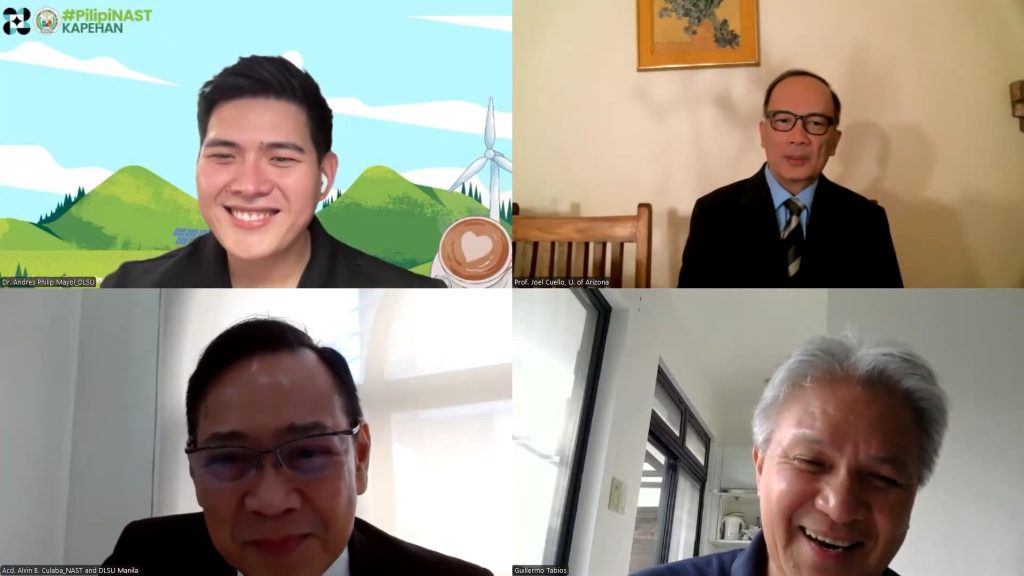
(First Row) Dr. Andres Philip Mayol, Corresponding Member Joel L. Cuello, (Second Row) Academician Alvin B. Culaba,and Academician Guillermo Q. Tabios III during the Q&A session of the January 2026 #PilipiNAST Kapehan
In celebration of the International Day of Clean Energy last January, three (3) esteemed NAST PHL scientists, known experts in various fields of engineering, shared their knowledge and expertise on sustainable energy and water resources. These include Academician Alvin B. Culaba, PhD Mechanical Engineering, Academician Guillermo Q. Tabios III, PhD Civil Engineering, and Corresponding Member Joel L. Cuello, PhD Agricultural and Biological Engineering. Dr. Andres Philip Mayol, PhD Mechanical Engineering, and one of the 2025 Outstanding Young Scientists, served as the moderator for the event.
During this episode, the panelists highlighted the importance of making sustainable and renewable energy work for the country, especially amid increasing resource consumption driven by globalization, innovation, population growth, and the growing use of Artificial Intelligence (AI).
Acd. Culaba stated that, given the world’s limited resources, people should always remember to apply the principle of conservation of energy. He stressed that people should conserve resources and make them more efficient and optimal by converting them into useful energy or applications. Acd. Culaba also emphasized that the country should prioritize resource assessments by gathering data on the sources available in a given area, how much they are, and whether the right people are in place to know what to do to make renewable energy work for the Philippines.
In terms of sustainable development for water resources, Acd. Tabios explained that experts and aspiring engineers should sequence or stage their developments over a planning horizon of five to six (5 to 6) generations (about 250 years) to enhance resource efficiency. He also emphasized that the rate at which we use our resources should be lower than the rate at which they are replenished to make the earth sustainable and support life, including flora and fauna, and help human settlements thrive for a very long time.
On topics related to AI, CM Cuello stated that the Philippines currently has one (1) hyperscale, AI-ready data center that sources a portion of its power from renewable energy and water resources, and that about four or five (4 or 5) more are under construction. However, he mentioned that, despite the technological advancements they provide for the country, they also raise concerns about power and water consumption. Provided this, CM Cuello elucidated that: “There needs to be a comprehensive, holistic, and integrative plan for the use of power, water, and land for sustainable Philippine development, considering as well food production and industry establishment.”
Acd. Culaba added that while the country wants AI to be fully utilized, the government and the public should be aware of its consequences. Acd. Tabios also suggested that future AI algorithms could potentially use analog neurochips instead of digital computation to reduce electrical energy needs.
The program ended with the panelists underscoring the importance of engaging scientists and government agencies, especially the Department of Science and Technology (DOST), to develop an integrated combination of expertise and to develop a multidisciplinary solution to complex environmental sustainability problems. They pushed the science communicators to continue writing articles and opinion pieces to mold the government and its various departments, as they are the catalysts for raising these issues.
The National Academy of Science and Technology, Philippines (NAST PHL) is an attached agency to the Department of Science and Technology (DOST), mandated to recognize outstanding achievements in scientific research and development, advise the President and the cabinet on matters related to S&T, and engage in projects and programs that promote scientific productivity. For more details, visit NAST Philippines’ social media accounts @nastphl.